Sarah's fall from a roof as a student
Down Cemetery RoadSarah Trafford’s fall from a roof as a student is a near-fatal accident shaped by a psychedelic vision: a real fire escape and roof become, in her perception, a route to the world’s highest point and a place where she can choose its fate. The episode turns the fantasy of flight into bodily pain and survival. Its consequences persist beyond the hospital, in a scar, in Sarah’s changed understanding of her apparent invulnerability, and in nightmares that return to the fall without ever showing its impact.
The ascent and the vision
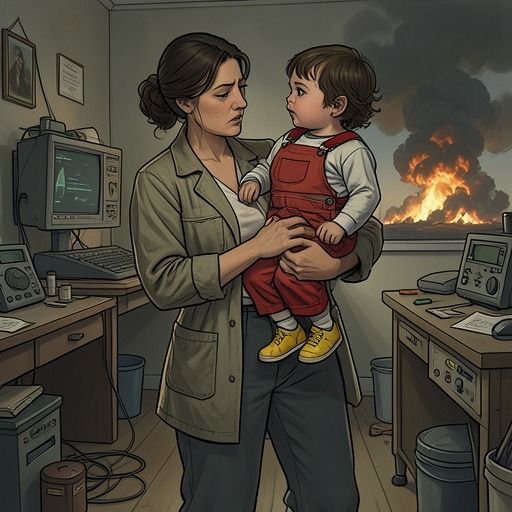
At a party, Sarah ignores a young man talking about acid and pushes through a door marked FIRE ESCAPE. The lettering seems to rearrange itself into a secret message meant for her. Beyond the door, the fire escape runs down the side of the house, but Sarah experiences it as a route upward: the lights of hell appear far below, the city grows brighter as she climbs, and the top of the structure becomes an undiscovered pole at the world’s center. The partygoer’s growing unease, and then his departure, cannot interrupt the mission that the vision seems to have assigned her.
At the summit she finds what looks like a playpen, yet seems to contain the whole world, its corners stretching into space. Two opposing sacred figures call to her. For a brief interval, Sarah believes she alone can decide the world’s fate. The appearance of The Other Sarah Tucker ends that imagined sovereignty: the other figure smiles with benevolence and moves toward her own corner, while the world is snatched from Sarah’s hands. The vision makes the roof not simply a height but a stage on which Sarah experiences choice, power, and their sudden loss.
The fall and its immediate meaning
Sarah interprets the scene through a rule of balance and inevitability. As The Other Sarah Tucker runs to her corner, Sarah, whom the narration also distinguishes as the Real Sarah and the Only Sarah, rushes toward the crooning deity. Because she believes she can float, she grips the railing to keep from being blown away. The people from the party reach the top too late to save her. Sarah remembers a dream of wingless flight that The Other Sarah Tucker has never had; when Sarah lets go, the act feels to her like release and submission to a truth she experiences as kind and inescapable.
The city lights cartwheel in her perception, as though the landscape rather than Sarah were being pulled out of the picture. One by one the lights go dark. The vision gives way to pain, and Sarah learns what the episode calls the secret of staying alive. The passage does not dwell on the physical mechanics of the fall or describe the impact. Instead, its decisive turn is from imagined flight to the recognition of bodily vulnerability: the experience that felt like release ends in injury and survival, not transcendence.
Injuries and hospital recovery
Sarah later recalls that she was repeatedly told how lucky she had been. She had broken three important bones and four minor ones, and had missed iron railings that, according to the account, might otherwise have impaled her. Her bruising made her look like a human mnemonic of the rainbow’s colours. Most of the bruises faded, but a scar remained on her upper left arm, usually hidden from view. Doctors worried about possible hidden injuries, but Sarah appeared to have suffered no brain damage.
A counsellor was assigned to address drug abuse, though Sarah regarded that treatment as the least necessary part of her care. Her psychedelic period was ending, and she became convinced that the sense of immortality associated with the drugs was temporary. She also concluded that she would never be able to fly. The difference between the two beliefs matters: the fall does not erase the memory of the vision, but it strips its promise of literal force. Sarah must live with both the remembered conviction and the knowledge her injured body has imposed.
Memory and aftermath
During her hospital stay, Sarah’s student past returns with an unusual freshness. The first hours after the accident remain inaccessible to her, while the period in hospital becomes available for repeated recollection, as though her current circumstances have opened doors in her memory. The fall therefore has two temporal forms: the confused episode itself, and the later act of replaying its aftermath. The account presents recollection as newly vivid without suggesting that Sarah can recover every part of the experience.
Visitors arrive in the first week, many guilt-ridden and religious, but their calls dwindle before a fortnight has passed. Her parents visit and weep at her bedside; Sarah cannot tell whether their tears are for her injuries or her behaviour. The doctors say she must remain in hospital for at least another fortnight. Sarah receives that news as a reprieve, a pause before returning home, rather than simply as a warning about her recovery. Later, her nightmares preserve the fall in a strikingly incomplete form: she never hits the ground. The accident’s bodily consequences are concrete, but its return in sleep suspends the moment before impact, leaving survival inseparable from an ending she does not experience there.